What Philosophy Taught Me About Coaching
Did you know that philosophy was my favorite subject in high school?
For a very simple reason. Philosophy taught me the importance of:
learning to think for myself,
questioning what seemed obvious,
accepting doubt as a fertile space rather than something to avoid.
Many moons later, I realize how deeply this approach still shapes my coaching practice — whether it’s uncovering limiting beliefs or challenging “surface-level” goals. Socratic thinking, in particular, feels like a powerful lens for reflecting on my posture as a coach.
Socratic Dialogue in the Service of Coaching
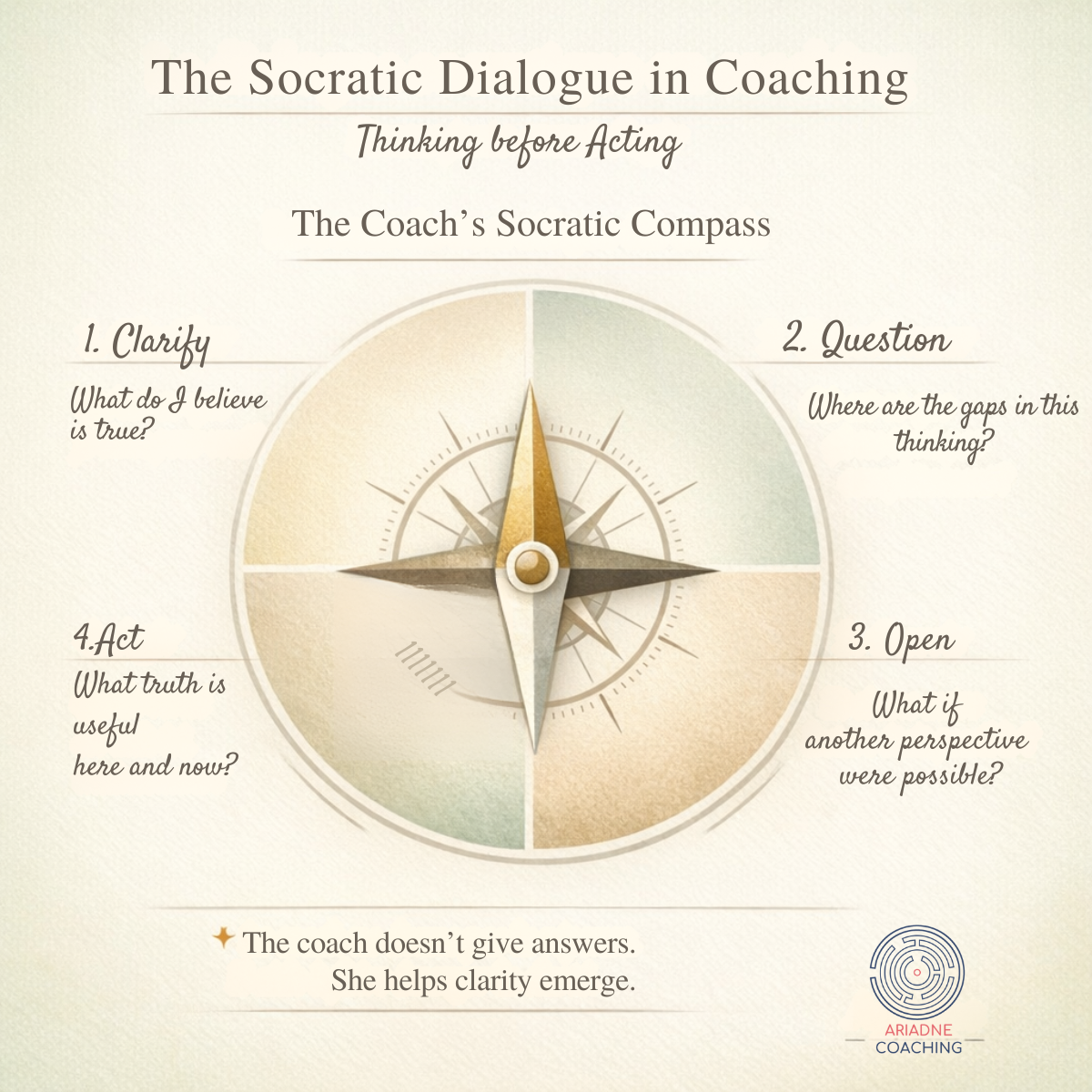
When I coach my clients, I often rely on what I consider a Socratic coaching dialogue, structured around four simple movements:
1. Clarify
What do I consider to be “true” or indisputable?
(facts, interpretations, beliefs)
2. Question
Where are the cracks — or where does this not fully hold together?
(inconsistencies, blind spots, exceptions)
3. Open
What if another interpretation were possible?
(moving beyond binary thinking, expanding perspectives)
4. Act
What new insight or truth is useful here and now?
(not the truth, but a fertile hypothesis to move forward)
The Coach’s Socratic Compass – by Ariadne Coaching
I’m sharing my Socratic Compass for Coaches through this simple visual, in the hope that it may also support you when you wish to adopt a leader-as-coach posture — whether in self-coaching or when supporting others.
In my experience, this type of questioning develops something truly valuable in the leaders and professionals I support through coaching:
👉 first, reflective autonomy
👉 then, the ability to slow down before acting
👉 and finally, more aligned decision-making